
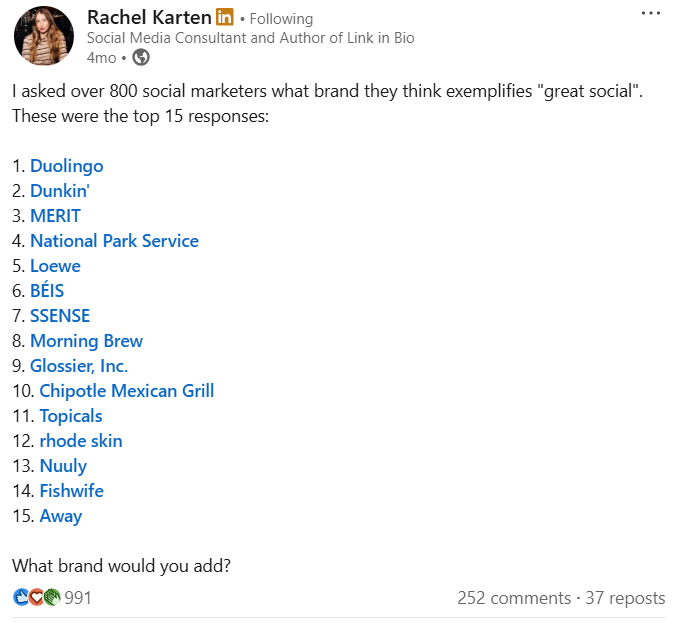
Recently, Rachel Karten (author of the Link in Bio newsletter) ran a survey asking 800 marketers a simple question:
Which brands are crushing it on social media right now?
When she shared the results, something interesting (and kind of shocking) stood out to me: not a single B2B brand made it to the top 10.
And honestly? I wasn’t surprised.
Because a few months ago, while researching B2B and SaaS companies for a project, I saw the exact same pattern playing out in their feeds and it finally clicked why.
Almost every B2B/SaaS brand is acting like a consumer brand on social media. They’re posting memes, TikTok-style content, jumping on trending bandwagons, all the stuff you’d expect from Duolingo or Poppi.
I don’t think there’s anything inherently wrong with this kind of content. In content strategy, there’s no universal “should” or “shouldn’t.” If it works, it works.
The problem starts when brands stick with this strategy even when the data is screaming that it’s not working. You scroll through their feed and it’s meme after meme, trend after trend, with some value-added posts sprinkled in between. Then you look at the engagement and it’s embarrassing:
500K followers getting less than 0.5% engagement
100K followers struggling to hit even 1% engagement
And no, it’s not “the algorithm” working against them. If anything, algorithms favor trend-based content. It’s the content that is working against them.
It’s uninspired. It’s misaligned.
There’s a reason there’s only one Duolingo. One Ryanair. One Morning Brew. One Poppi. One Surreal. One Oatly.
Guess what’s common in all of them? They all have their own distinct style and voice. These brands do what they do because they know their audience inside and out.
Over time, they’ve carved out a strategy that fits them. It’s their signature.
Ryanair can tweet absurd stuff and be unhinged because they’re talking to college students booking €20 flights.
Morning Brew delivers business news with sharp wit and sketch-style comedy because it fits their tone, their audience, and their brand DNA.
But you? You’re selling CRM tools to executives in suits and you’re going unhinged, hoping it feels edgy and somehow drives results? It won’t. It clearly isn’t working.
Do you really think they laugh at the same jokes as 20-year-olds do? Their humor is different.
And don’t say, “We’re being experimental.” Yeah? You’re being experimental, and yet in the past year, you haven’t posted anything new or original. Just what everyone else is doing.
True experimentation means developing fresh ideas, innovative formats, and unique content angles that actually speak to your audience’s needs.
Copy-pasting what everyone else is doing isn’t experimentation. Or is it?
Some B2B brands are quietly getting this right. For example, Clay’s LinkedIn content doesn’t chase trends. It publishes GTM insights that their audience actually saves and shares. I think that’s the standard worth chasing.
So, what’s the solution? I’m not entirely sure, but I think it starts with asking one honest question: would my specific audience (the person actually buying what I sell) find this genuinely useful, interesting, or funny? Not “we need to hop on this trend.”
This single filter would eliminate most of the misaligned content flooding B2B feeds right now.
Also, I believe many of these brands would benefit from bringing in someone who deeply understands the industry, a creator or strategist who speaks the language of their buyers, can translate complex ideas into compelling stories, and doesn’t need to force trends to stay relevant.
Because that’s what all the great ones have in common. They truly understand their audience and know what resonates with them.
Let me know your thoughts on this!
___